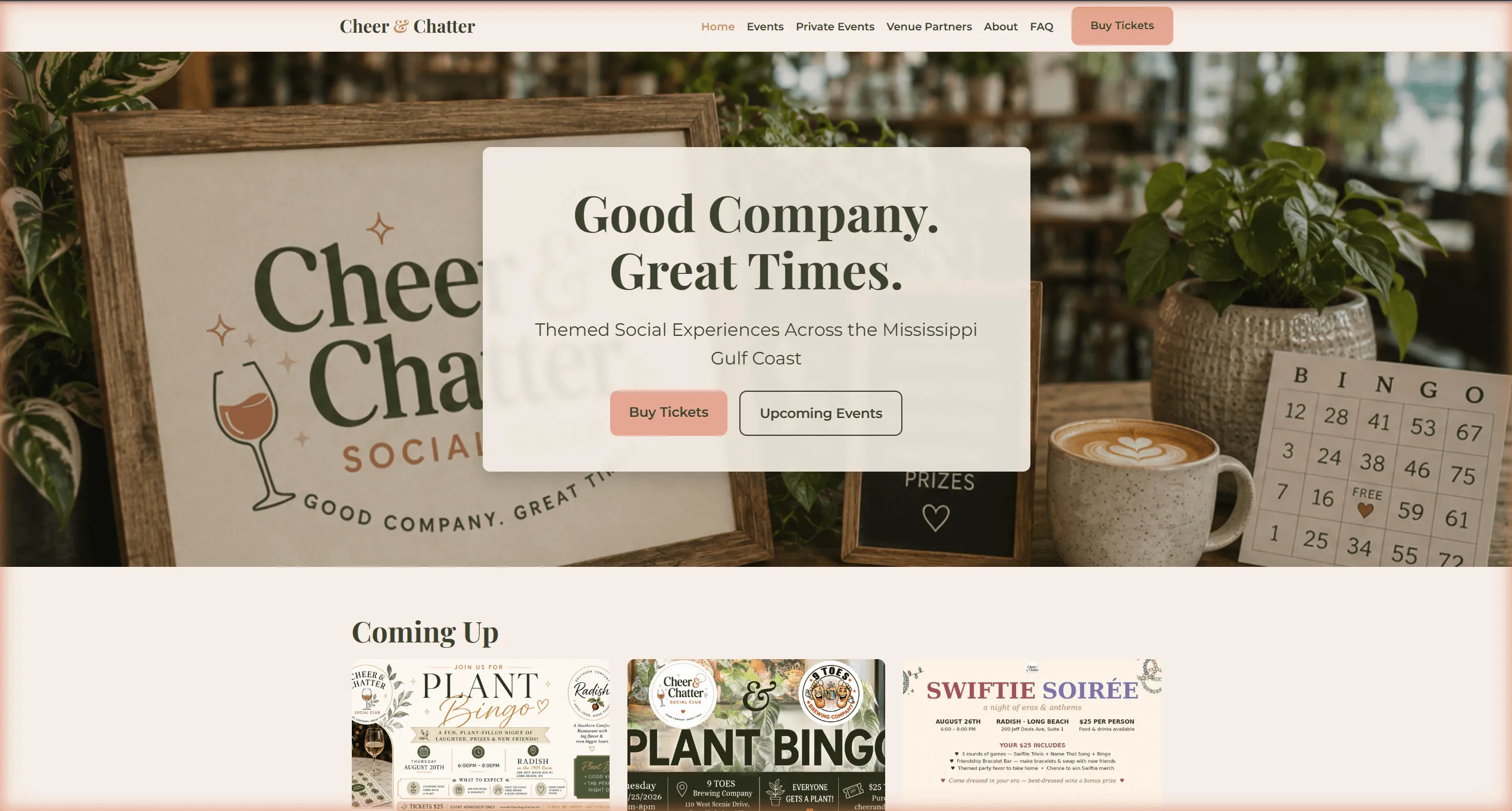
Cheer and Chatter Social Club runs themed game nights across the Mississippi Gulf Coast. Plant Bingo, Blind Date with a Book, Harry Potter Bingo, murder mysteries, private bookings. A couple with three young kids building the kind of gathering place they wished existed, where people put their phones down and meet each other.
They came to us as the business was being stood up, needing two things: a site that sells tickets, and a way to actually run game night. Six weeks later both were real, and had been proven in front of paying rooms: the site went live on day thirteen and the first two ticketed nights sold out.
The site
A marketing and ticketing site where the owners control every word without touching code. Events, venues, page copy, and game content all live in Sanity; the site rebuilds itself on every publish and again each morning, so yesterday’s event retires itself without anyone remembering to do it.
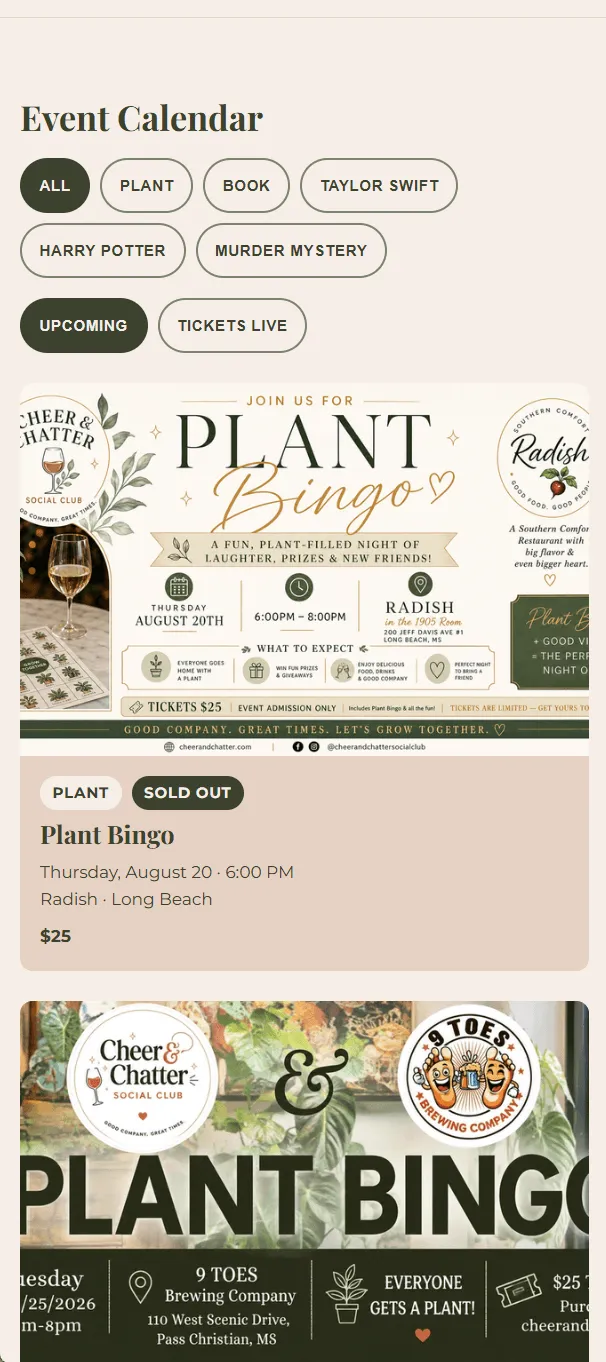
Ticketing is content too. The owners drop a ticket link into a field, the site checks it against a short list of platforms it trusts, and builds the checkout page itself, on the club’s own domain. When the last ticket sells, the box office tells the site directly. The page flips to sold out by itself, and flips back if a ticket is refunded. On event day, nobody touches anything.
The same discipline runs through the whole model: there is a field for everything and everything lives in its field. The event page, the calendar cards, the search listing Google assembles, and the waitlist email that names the right night are all composed from the same structured facts, entered once.
Every vendor account belongs to the owners. Domain, hosting, content studio, email, ticketing. If we vanished tomorrow, they lose nothing.
House rule: the client owns their own shop. We hold keys, not deeds.
The live event application
The interesting half. Game night needs a caller, a board, and a room that can see both. So the site grew an auth-gated live area: the host runs the night from a phone, and the venue TV shows the crowd screen. The two pair by a five-character code, connect from any network, and stay in sync through a small realtime worker that costs nothing while idle.
Pairing by typed code rather than a cast button is not a shortcut, it is the only door iOS leaves open. An iPhone can mirror itself to a television, but mirroring throws the whole device at the room, host console and all, which is precisely the setup the two-device design exists to replace. Handing a page to the TV’s own browser is not something iOS will do, and every alternative costs the client hardware. So the code got designed properly rather than apologized for: five characters from an alphabet with no lookalikes in it, remembered by both devices, typed once at the first venue.
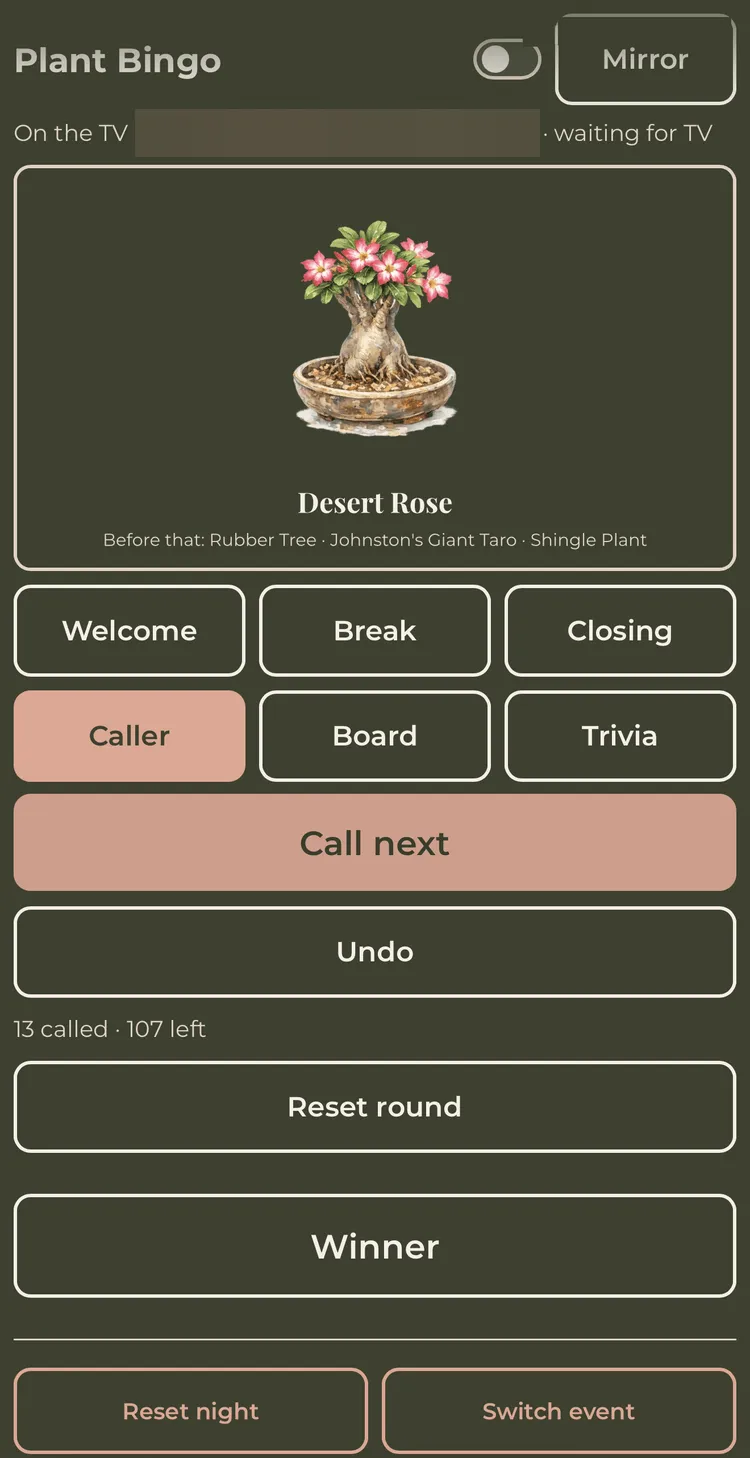
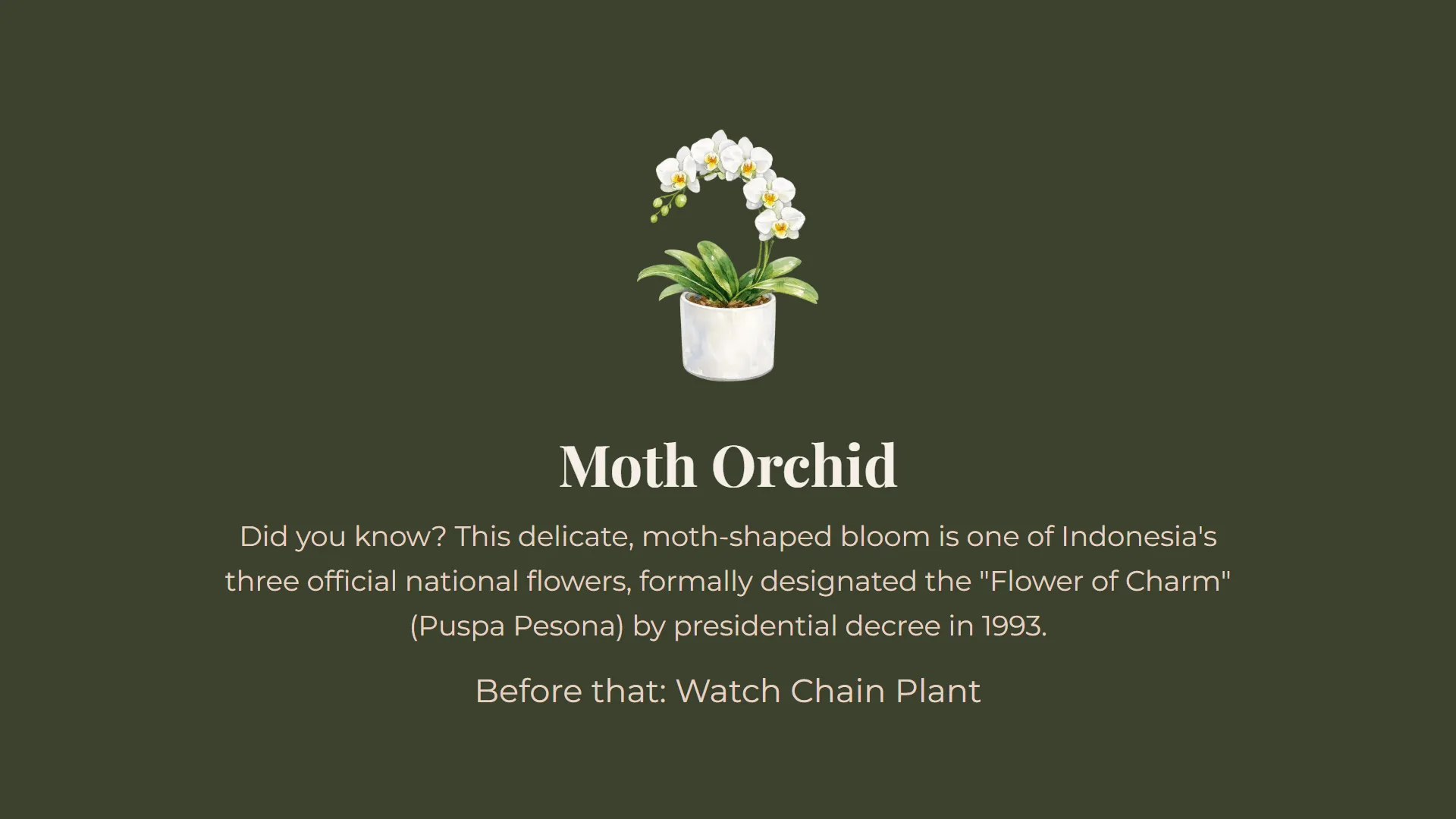
Bingo came first and ran a real room on August 8. Then trivia grew from a footnote into a round system: a tap starts the next round at a chosen difficulty, from a gentle opener up to a Final Boss round, no question ever repeats across a night, the TV holds a round splash while the host works the room, and every tier button carries a live count of what’s left. The best code is the code a sharp data model makes unnecessary.
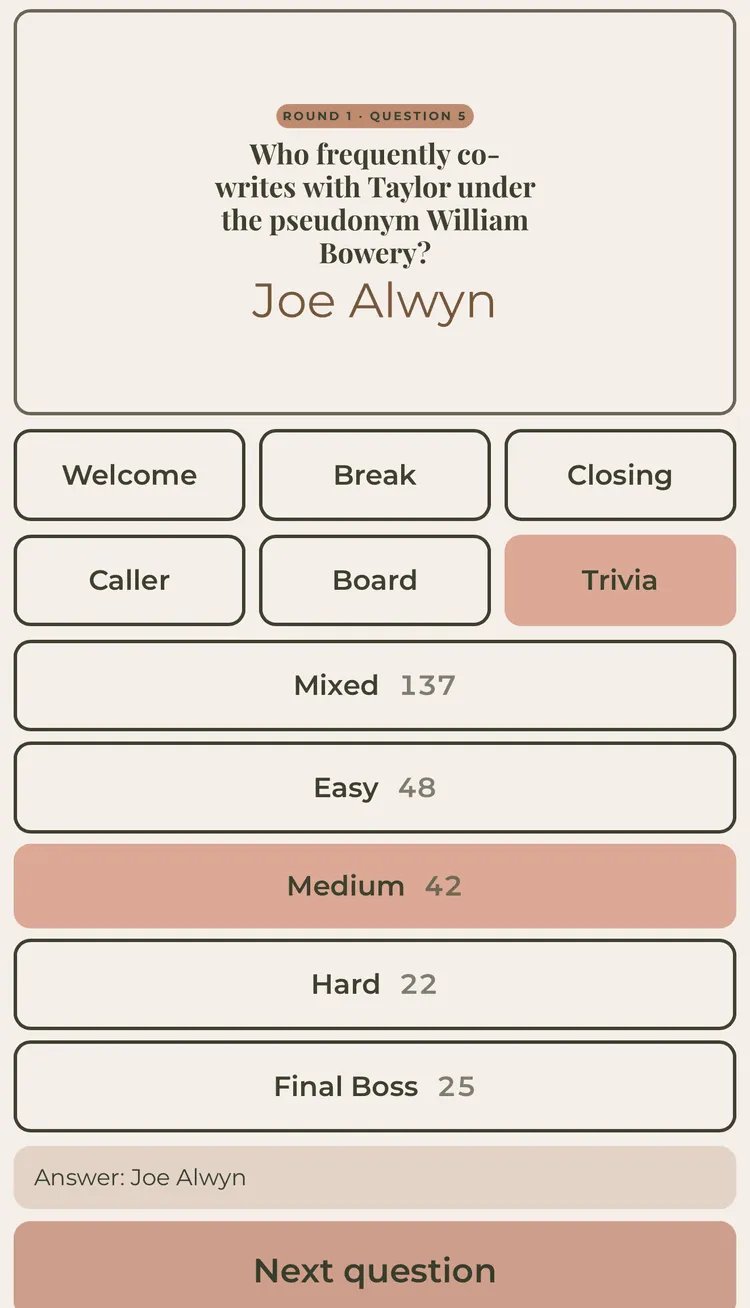
The content pipeline behind it: nine hundred forty-two trivia questions and four hundred fifty-one pieces of caller art across four full photo decks, parsed out of the owners’ own documents and catalog PDFs by import scripts that write to the practice dataset unless told otherwise in as many words. Before an event, the night’s art caches onto the device, so a venue with bad wifi cannot take the show down. If the phone dies mid-round, the whole night resumes where it stood: board, winners, round, and which questions have been asked.
We rehearsed the whole thing in a living room with a phone and a smart TV before the first real night. Rehearsal catches what tests cannot, including a TV keyboard that capitalizes room codes. The round system got the same treatment: run exhaustively in development, then rehearsed by the owners at their own house before it took a paying room.
The break screen
Everything in the app holds still on purpose; the content is the show. The one exception is the break screen: an auto-advancing loop that thanks tonight’s venue, shows the club, and gives sponsors a card. Its centerpiece is ours: a continuously rotating 3D model on the Birch Design Lab card, compressed from a 12MB export to 3MB, judged by eye against the original before it shipped, with a committed still of the model standing behind it as the no-JavaScript insurance. The rule that the whole screen obeys was written down before the first frame moved: nothing the room sees may depend on code that might not arrive.
The controls they keep
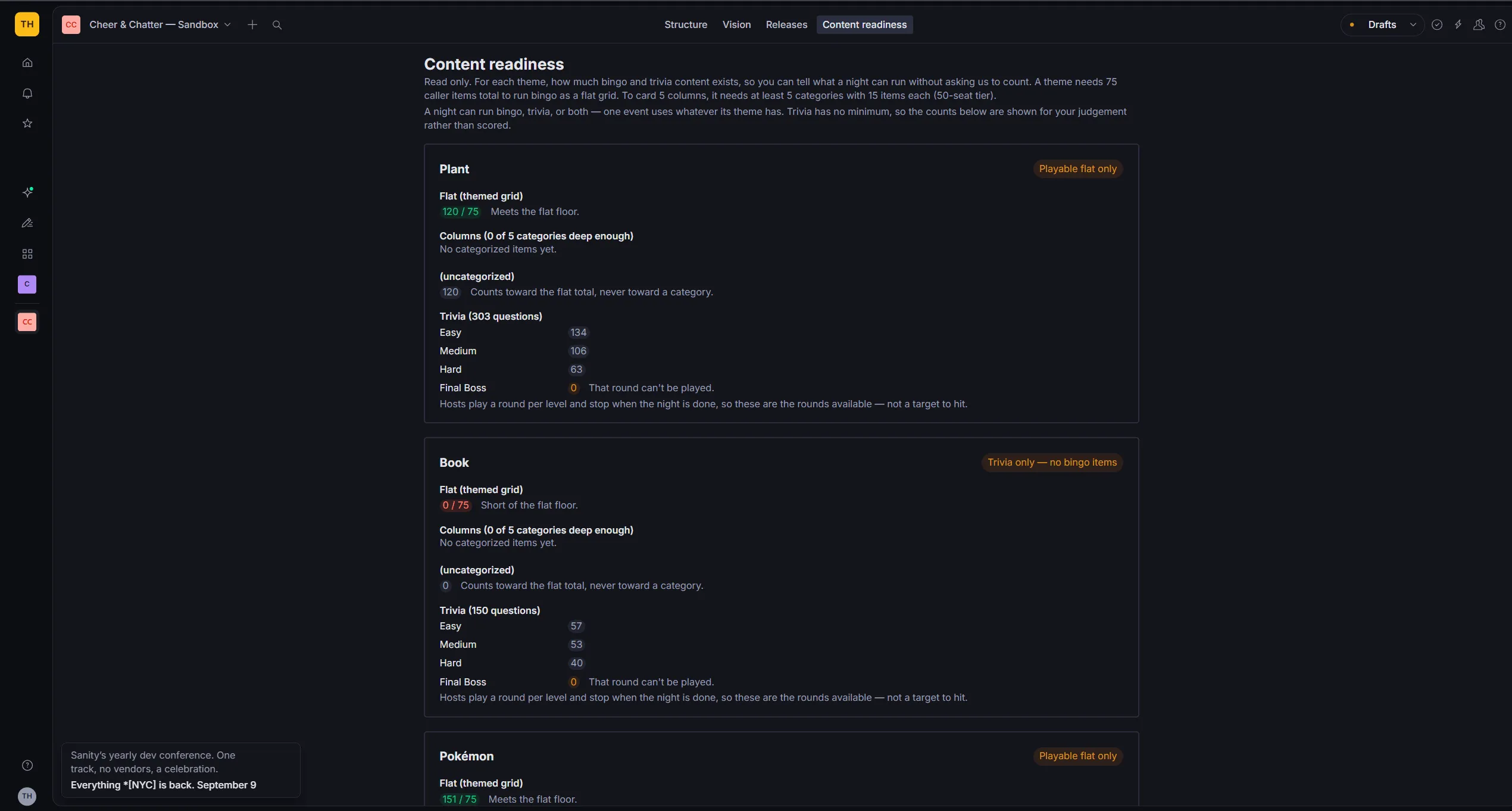
The owners run everything through Sanity Studio, including a readiness gauge that counts their content pools per theme, per difficulty, so they know a night is playable before they announce it. The gauge is honest enough to say “enough for a smaller card” instead of failing a 60-item deck that was built for a 3x3 night. The event picker only lists nights that can actually run. Validation talks like a person: a duplicated event still carrying its original’s web address gets a sentence telling the owner exactly which button fixes it, because the failure it prevents is two events sharing one page and one mailing list.
In the room
Software for a live event only proves itself in the room, so we kept turning up to the rooms.
At one August night at the original venue, the television ran behind the host’s phone. The screens are mounted out of reach, with no HDMI a device can borrow, so the only way onto that TV was an iPad mirroring itself across a single bar of borrowed wifi, and a continuously rotating 3D frame is the worst thing you can ask a mirror to compress. The lag looked like the app’s fault. It was the mirroring link, and we could measure the difference. The response was to make the app stop depending on the part of the chain it does not control: the night’s photos and the 3D decoder now cache onto the device before doors, the crowd screen installs as a standalone app with no browser chrome, and a readiness line confirms it all arrived before the room fills. The screen that lagged was exonerated, and we hardened it anyway.
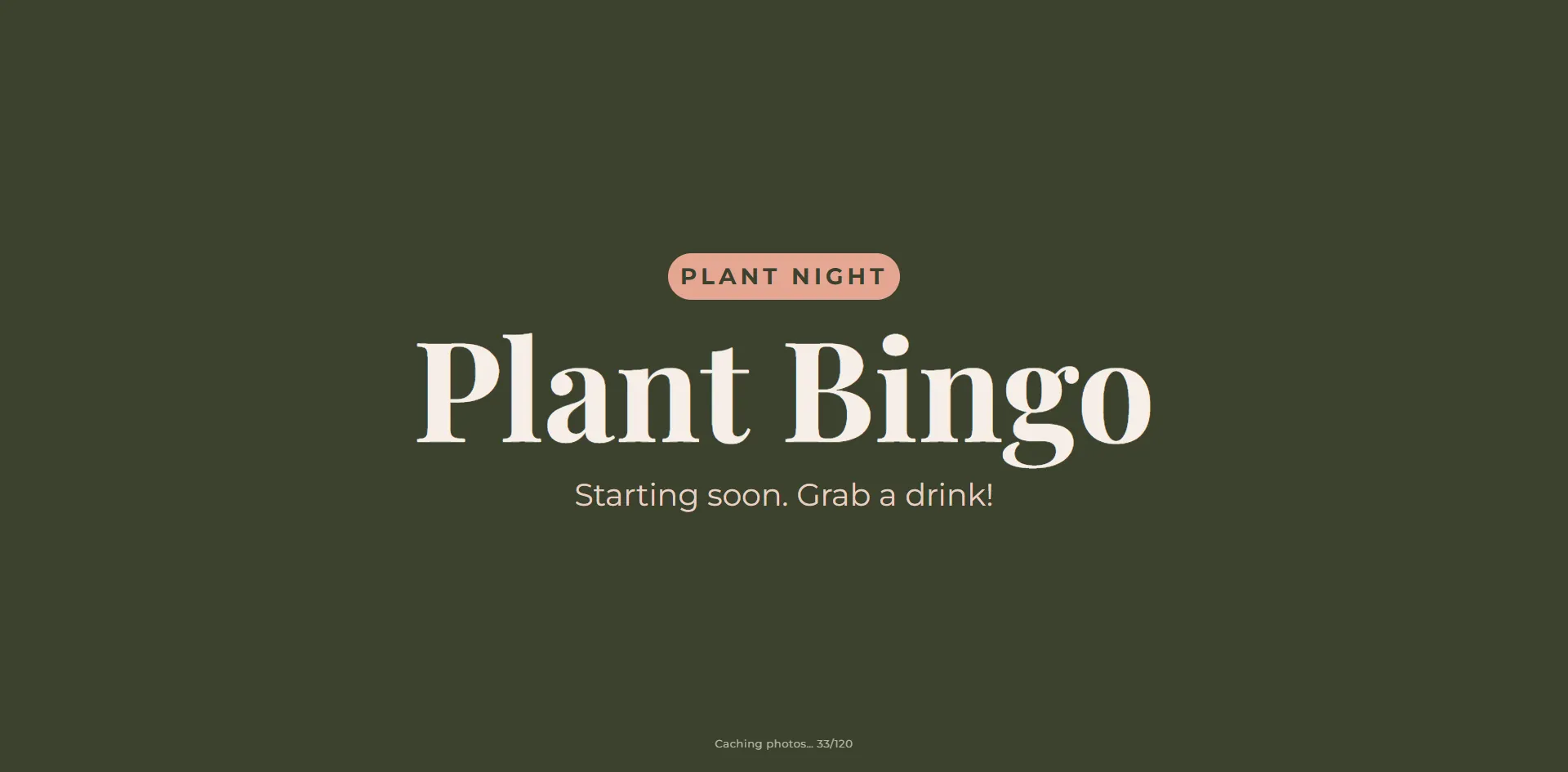
The night also learned how to end. One host tap sends the TV into a send-off rotation that thanks the room and the venue and finishes on a card carrying a QR to the next events, with a discount that expires two hours later. The app used to end when someone turned the television off. Now the room leaves scanning.
Then the two-device model traveled. A second venue, a new network, the same five-character code, and a room that sold out and then some: sixty tickets gone before the doors opened, and the extras the owners carried in to sell at the door gone as well. And when a small friction surfaced in that paying room, the previous winner lingering on the TV while the host typed the next name, it was root-caused, fixed, checked against the whole test suite, and merged before midnight the same night.
The fixes came the same night as the events that revealed them. Shipped and tested is not the same as played, and played is where the last bugs live.
The shape of the work
Six weeks from first commit to a delivered v1, and the engagement has continued past it into live operations. Nineteen thousand six hundred eighty-five lines of code across the application and its supporting scripts and tests, in six hundred fifty-one commits across one hundred ninety-two merged pull requests, five hundred sixty-two automated tests green, and two owner manuals written against the finished system so the site and the live app can be run without calling us. The site launched on day thirteen and sold out its first two ticketed nights; the live application has since run four real rooms across two venues, with more on the calendar.
Everything on this page is the same kind of work the Lab practices in the open. The experiments are how we sharpen it; this is where it cuts.